

“Is LVT waterproof?” is usually asked by someone choosing a floor for a kitchen or bathroom and worried about the day the washing machine leaks or the bath overflows. The product answer is reassuring. The installation answer is where the real difference lies.
The Short Answer
Many LVT products are sold as waterproof, and the reason is the material. Vinyl does not absorb water, so a spill, a wet footprint or a dripping dishwasher will not swell, warp or stain the surface the way it would laminate or real wood.
The wording varies between products, though. Some manufacturers describe their LVT as waterproof, others as water-resistant, often because of how the joints or the core are made. And either word describes the planks or tiles themselves, not the floor once it is fitted. The manufacturer’s guidance for the specific product, including where it can and cannot be used, is what to check before choosing a floor for a kitchen or bathroom.
What the vinyl cannot do is seal the gaps around it. A finished floor is only as good at keeping water out as its seams, its edges and what it is stuck to. Water that finds its way through a joint or down the side of a bath may not harm the vinyl itself, but it can damage the adhesive, the subfloor and anything underneath. That is how a floor made from a “waterproof” product can still fail.
Glue-Down Or Click LVT In Wet Areas?
LVT comes in two broad types. Glue-down tiles are bonded directly to a prepared subfloor. Click LVT locks together and floats over the floor beneath it.
Every LVT project we have published, including our open-plan installation in Cringleford and the kitchen in Lowestoft, was glue-down. Which type suits a particular kitchen or bathroom depends on the product and the room, and the manufacturer’s guidance for each product sets out where it can be used.
LVT In Kitchens
Kitchens are where LVT earns its reputation. It shrugs off spills, is easy to clean around the cooker and the sink, and is softer and warmer underfoot than ceramic tile when you are standing at a worktop.
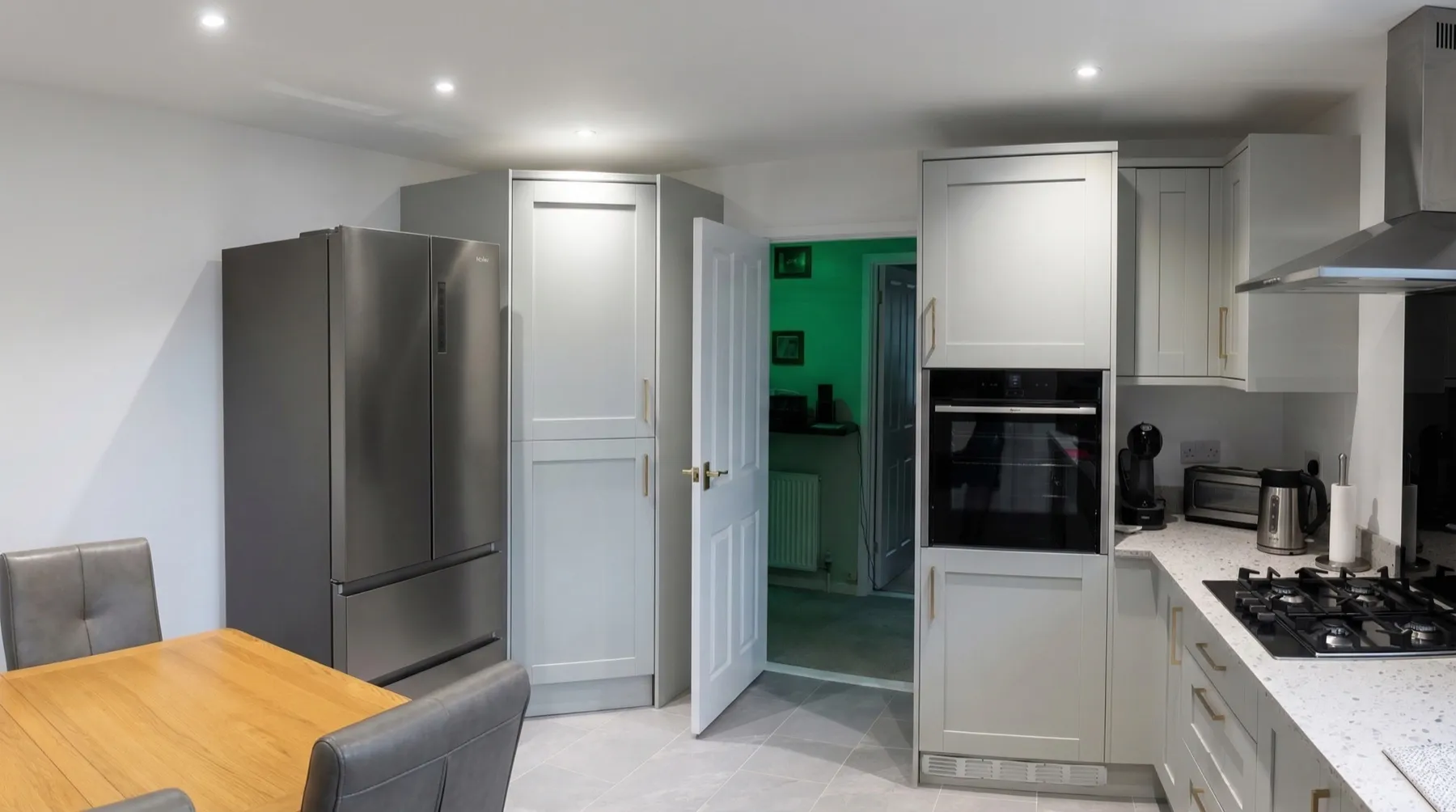
The question that matters most is sequencing: does the floor go down before the units or after them? On the Lowestoft kitchen, the subfloor was prepared and the tile-effect LVT laid before the new kitchen went in, so the floor runs continuously beneath the units with no cut edges hidden behind the plinths.
LVT also works where the kitchen opens into the rest of the house. On a full house renovation in Norwich, Nordikka herringbone LVT was laid from the new kitchen through the open-plan living space and into the hallway, so one floor copes with cooking spills at one end and muddy shoes at the other. Our guide to herringbone LVT covers that project in more detail.
If you are planning a full kitchen, our kitchen installations page explains how the flooring fits into the wider project.
LVT In Bathrooms
LVT is a common choice for bathroom floors, including family bathrooms, ensuites and cloakrooms, where it is warmer and softer underfoot than tile. Whether a specific product is suitable for a bathroom, and how it should be fitted there, is set out in the manufacturer’s guidance.
The weak points are the junctions. The edge of the bath, the base of the WC, the shower tray and the pipework all create gaps where water can get under the floor if they are not detailed properly.
Our bathroom installations page covers how tiling, plumbing and flooring are coordinated in a bathroom renovation.
Moisture From Below
Spills are the obvious risk, but the less obvious one comes up through the floor. A concrete slab that has not fully dried, or that has no effective damp proof membrane, will push moisture into the adhesive from below. The vinyl itself may not be harmed, but the bond holding it down can fail, and the floor starts lifting at the edges.
That is why solid floors are moisture tested before anything is laid. Our guide to laying LVT over an existing floor explains the testing and preparation each type of subfloor needs.
LVT, Tiles Or Laminate In Wet Areas?
| Consideration | LVT | Ceramic or porcelain tiles | Laminate |
|---|---|---|---|
| Surface water | Vinyl surface does not absorb water; joints and edges are the weak points | Tile does not absorb water; grout is porous unless sealed | Core swells if water gets into the joints |
| Underfoot | Warmer and softer | Hard and cold without underfloor heating | Warmer, but noisier |
| Dropped items | Forgiving | Items and tiles can break | Forgiving |
| Repairs | Individual glue-down tiles can usually be replaced | Individual tiles can be replaced | Usually means lifting a section |
For most kitchen and bathroom floors in an ordinary family home, a suitable LVT product, fitted properly, is a practical choice.
What Does It Cost?
Our indicative range for LVT flooring runs from around £500 to £15,000, from a single room on a sound base to a whole ground floor needing full preparation. A bathroom floor is usually towards the lower end, since the area is small, but the detailing around fittings takes time. The renovation costs and pricing guide explains what moves a project up or down the range.
Planning A Kitchen, Bathroom Or LVT Floor In Norwich Or Norfolk?
We survey the existing floor and the room before quoting, so the preparation and the detailing around the wet areas are priced in from the start.
Our LVT flooring page sets out how each stage of an installation is handled.
If you are planning a kitchen, bathroom or flooring project in Norwich or the surrounding area, get in touch to arrange a survey.