

This is the question we are asked most often about LVT, usually by someone hoping the answer is a straight yes. The honest answer is that the floor underneath matters more than the floor going on top of it, and it is where most disappointing LVT installations are decided.
The Short Answer
LVT can go over an existing floor if that floor is sound, dry, clean and flat. All four, not three.
What it cannot do is hide anything. Luxury vinyl tile is only a few millimetres thick and it is flexible by design. It follows whatever it is laid on. A dip telegraphs through as a visible hollow, a proud screw head shows as a bump, and a tile grout line eventually appears as a ghost line across your new floor.
That is why preparation is the majority of a good LVT installation, and it is the part nobody photographs.
Over Floorboards
Floorboards are the most common starting point in older Norwich properties, and the one that needs the most attention.
Boards move, cup and gap with age. Even boards that feel solid underfoot are rarely flat enough to take LVT directly. The usual answer is to overboard with plywood, typically screwed down at close centres, which gives a continuous flat surface and stops any individual board moving independently.
Skipping that step is the single most common reason an LVT floor looks wrong a year later. The board joints appear as lines, and nothing can be done short of lifting the floor.
Over Tiles
Tiles can be a good base, because they are usually stable and well bonded. The problem is the grout lines.
Grout joints are recessed by a millimetre or two, which is more than enough to show. The floor is normally primed and then taken flat with a self-levelling compound, which fills the joints and gives a continuous surface.
Before any of that, loose or hollow-sounding tiles have to come up and be made good. Laying over a tile that is already lifting simply moves the problem under your new floor.
Over Concrete Or Screed
Concrete is the most straightforward base, with one important condition: moisture.
A slab that is not fully dry, or that has no effective damp proof membrane, will push moisture up into the adhesive. LVT itself is unbothered by water, but the bond holding it down is not. Moisture testing before installation is the step that prevents a floor lifting at the edges a year in.
Most slabs then want priming and a smoothing compound to take out the undulations that are invisible until something thin and glossy is laid over them.
Over An Existing Vinyl Or Laminate Floor
Usually, no. Laminate is a floating floor and moves, which is the opposite of what a glue-down floor needs beneath it. Existing cushioned vinyl is too soft and compresses under point loads.
Both normally come up. It is quicker than the alternative, which is lifting a new floor later.
What Proper Preparation Looks Like
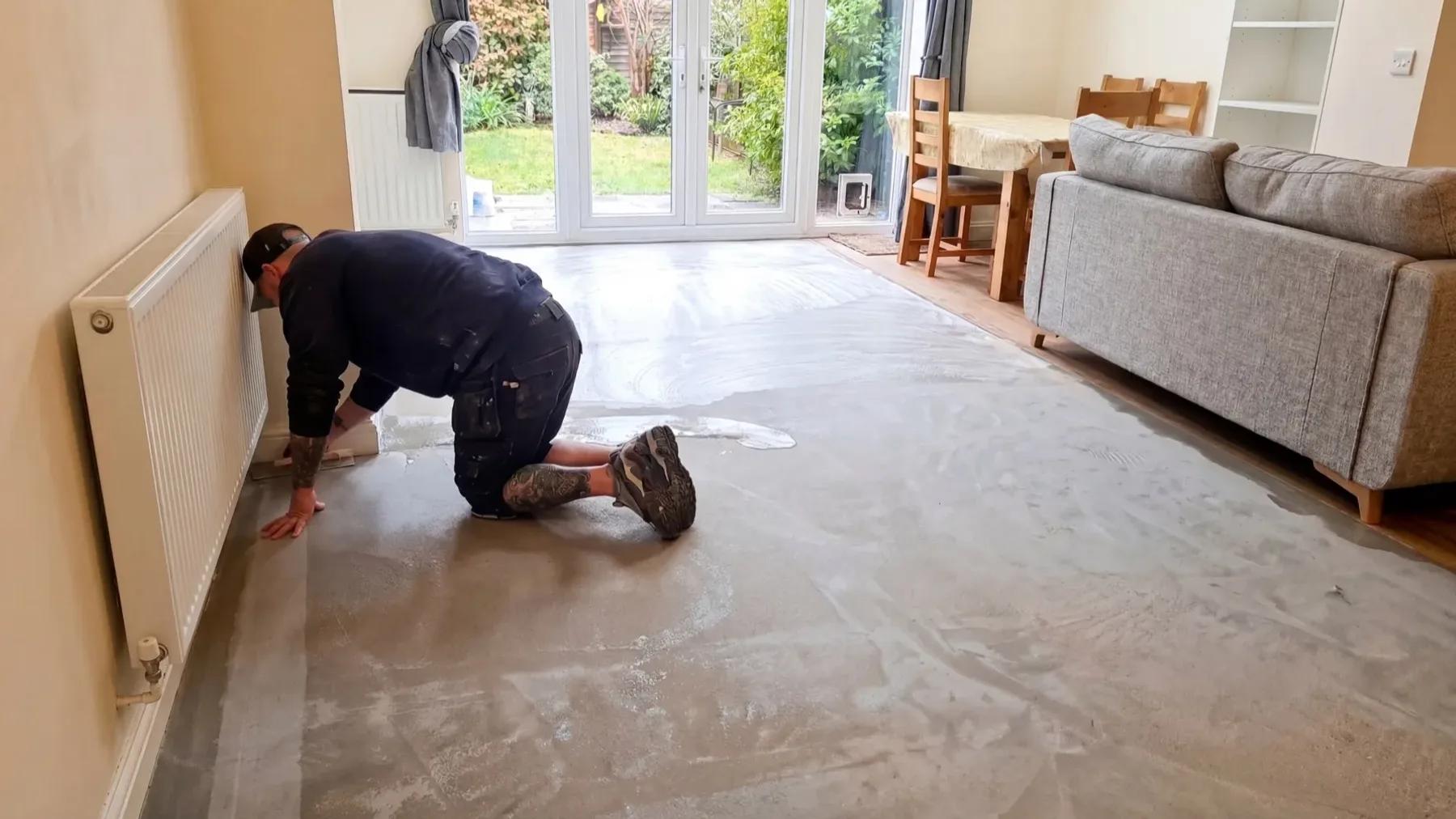
On a recent open-plan LVT installation in Cringleford, almost all of the work happened before a single tile was visible. The subfloor was assessed, primed, smoothed and levelled, and only then was the glue-down floor laid.
The same sequence ran through a full house renovation in Norwich, where herringbone LVT was carried continuously from the kitchen through the living space and out into the hallway. A pattern like herringbone is particularly unforgiving, because every tile meets three others and any deviation compounds across the room.
Both projects are photographed at every stage, including the unglamorous ones.
Questions Worth Asking Before You Commit
If you are getting quotations, these four questions separate a considered price from an optimistic one.
- What are you doing to the subfloor? If the answer is nothing, ask why not.
- Have you tested for moisture? On any solid floor this should be automatic.
- Is the preparation included in the price? Preparation discovered later is the most common reason an LVT quotation moves.
- What happens at doorways and thresholds? Running a floor through several rooms is where levels between spaces have to be resolved.
Does Preparation Make It Expensive?
It makes it honest. Our indicative range for LVT flooring runs from around £500 to £15,000, which is wide because it covers everything from a single room on a sound base through to a whole ground floor needing full preparation. The renovation costs and pricing guide sets out what sits at each end.
A quotation that leaves preparation out is not cheaper. It is incomplete, and the difference usually appears once the old floor is up and the work is already underway.
Planning An LVT Floor In Norwich Or Norfolk?
We survey the existing floor before quoting, so the preparation is priced into the job rather than discovered during it.
Our LVT flooring page covers how each stage is handled, and our guide to what order to renovate a house in explains where flooring belongs in a wider project.
If you are planning new flooring in Norwich or the surrounding area, get in touch to arrange a survey.